The Ethics of Ambiguity
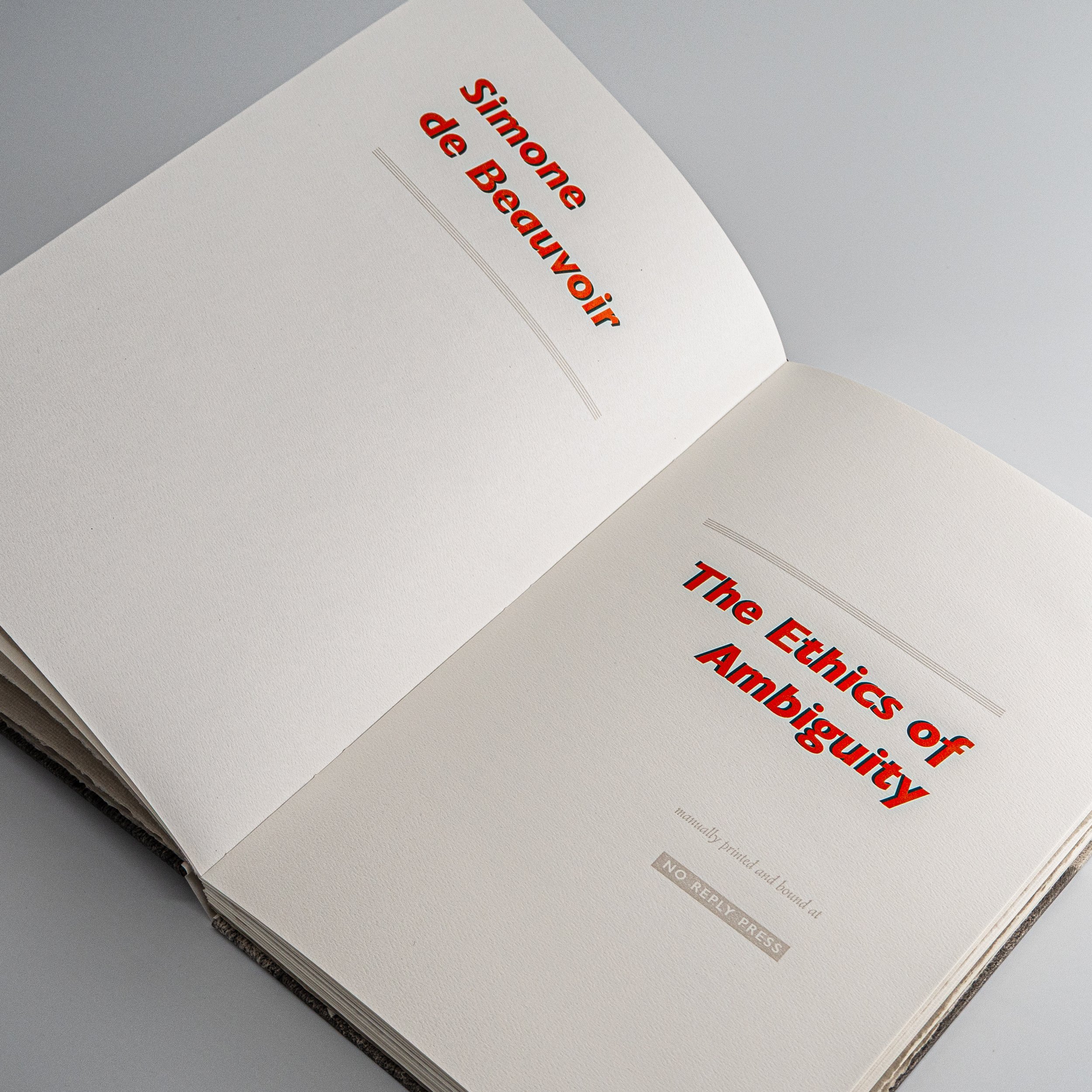

The Ethics of Ambiguity
A BOOK BY SIMONE DE BEAUVOIR⠀•⠀EACH COPY WITH A UNIQUE SUITE OF ARTWORKS CHOSEN BY ITS OWNER
Simone de Beauvoir is one of the most underrated philosophers of the twentieth century. Unique among the French Existentialists, de Beauvoir’s philosophical achievements have rarely been acknowledged. This lack of appreciation is unfortunate, because with The Ethics of Ambiguity she helped re-conceive the idea of freedom in light of the breakdown of pre-modern ethical systems. I am proud with this edition — my most ambitious at the time of its publication — to revise this transformative yet forgotten treatise.
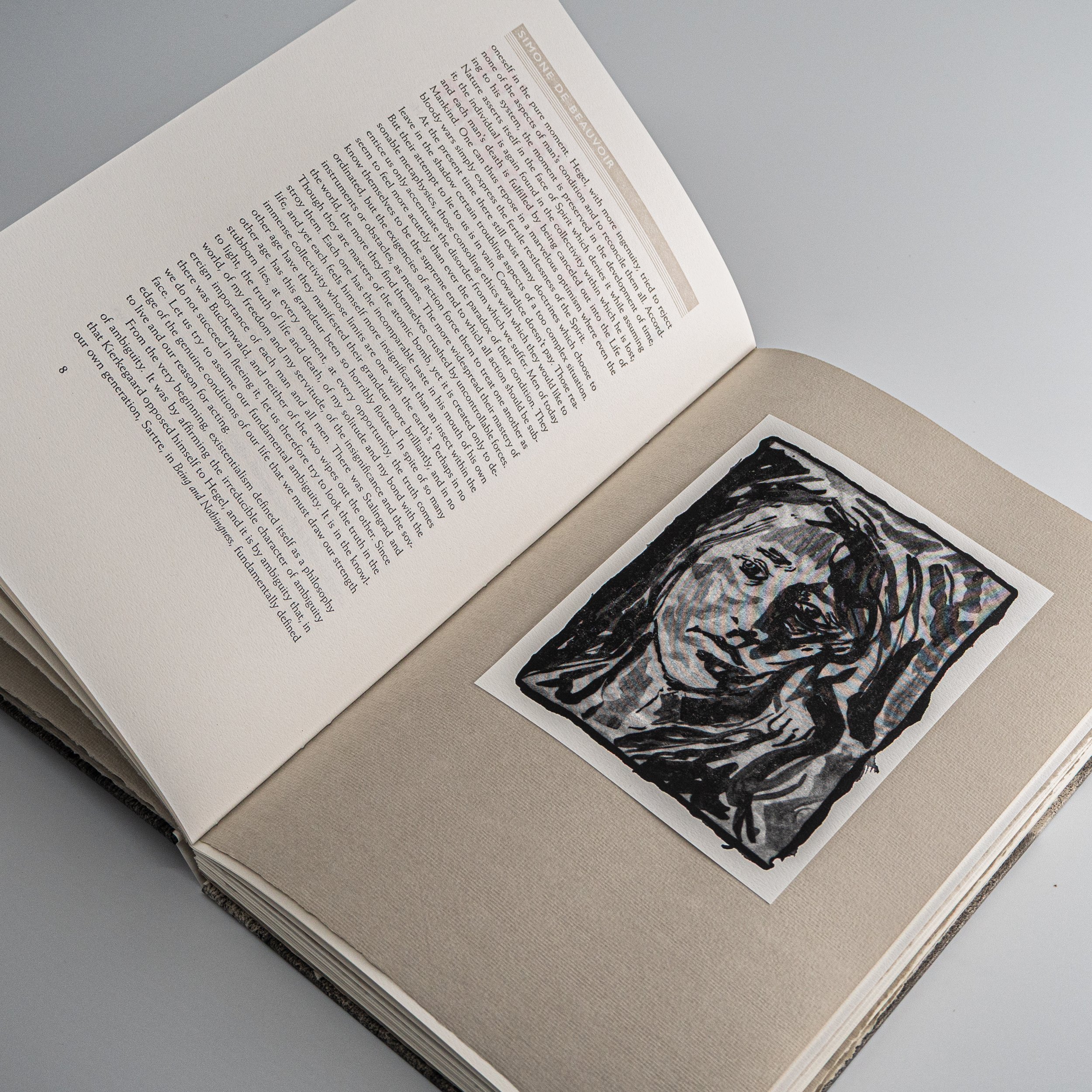
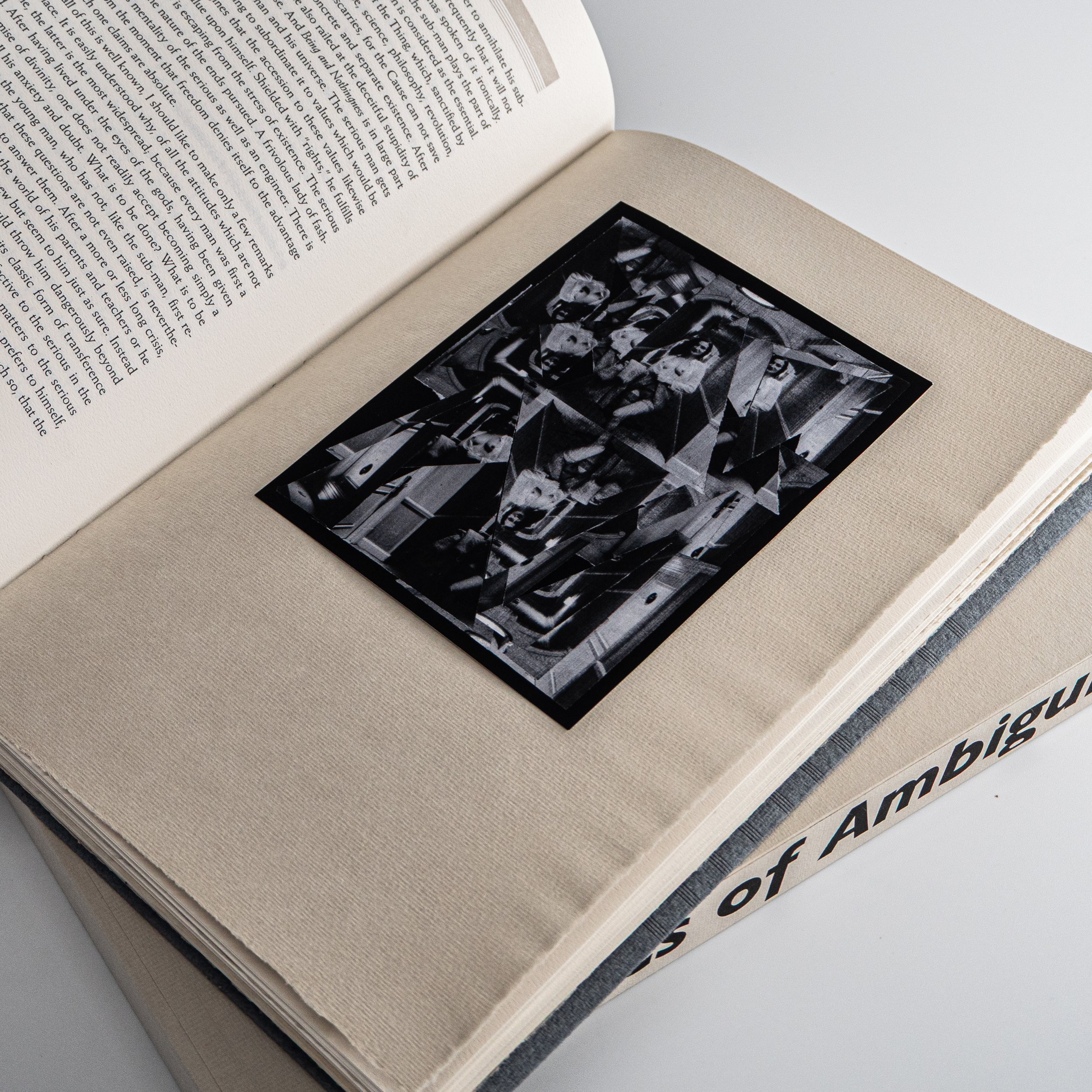
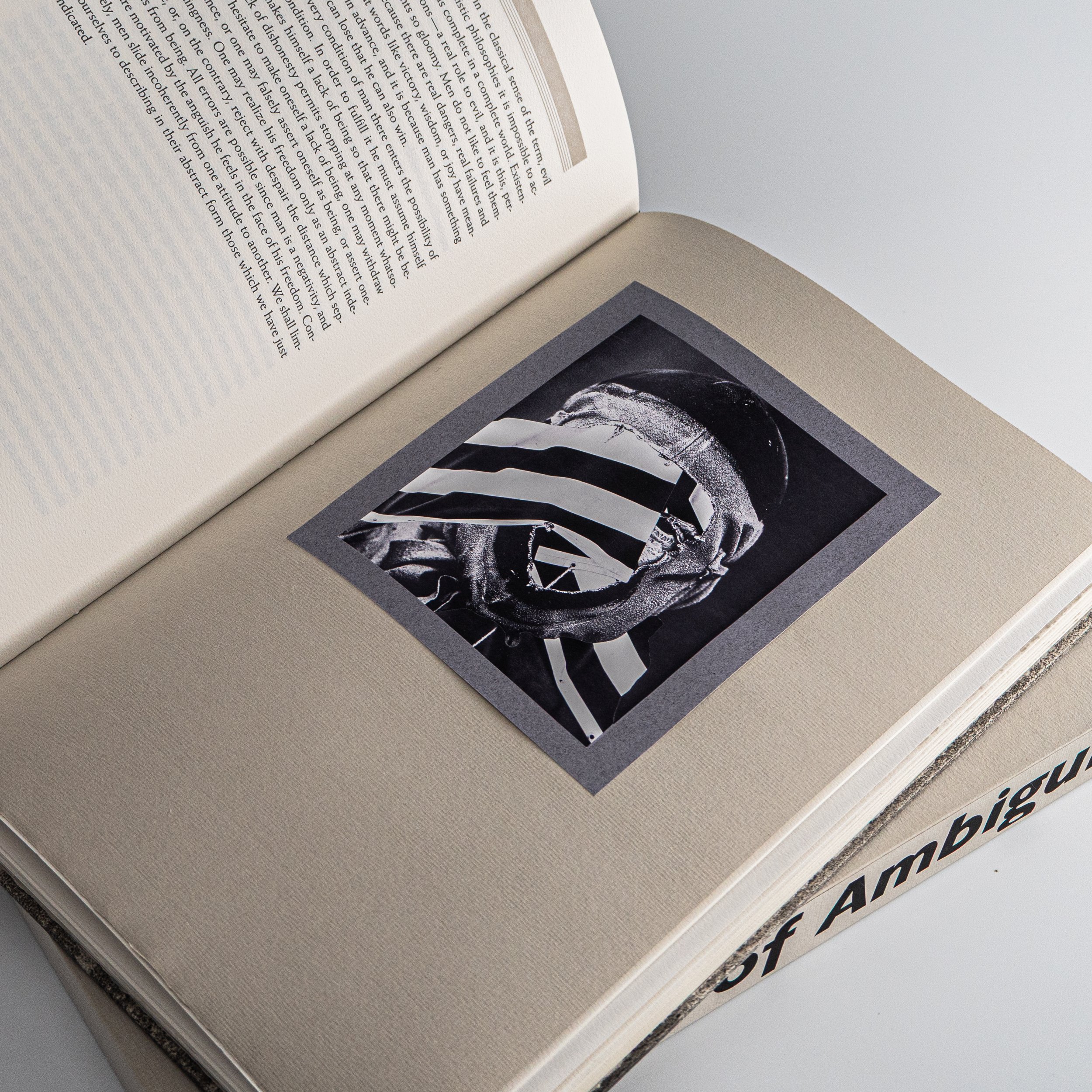
And to do so with its own experiment in “radical freedom:” This might be the first private press edition which asked its collectors to choose their own artwork. At least, I have no been able to find any other. Each subscriber to the edition was presented with three suites of twenty commissioned artworks by pseudonymous artists — Ester Kärkkäinen, CONTENT IS USING ME, and Vincent Van Villain. After choosing an artist, they chose twelve artworks and their order of presentation. In this way, no two copies are alike. In fact, no two copies are even particularly similar. The ensuing variation was remarkable, down to the fact that of the seventy copies, the edition is evenly divided: twenty-three feature Ester Kärkkäinen, twenty-three feature CONTENT IS USING ME, and twenty-three feature Vincent Van Villain. (And then there’s my own copy to break the three-way tie — but I won’t say who I chose.)
The reactions to these artworks were just what I hoped they’d be: strong, mixed, and evolving. Some collectors immediately connected with a particular artist’s work. Some hated one or other. Many vacillated between them. The correspondence I received from collectors grappling with these artworks was heartening; many did the hard work of true art appreciation, moving beyond gut reaction toward deeper considerations. That’s just wonderful. After all, The Ethics of Ambiguity is about the situation that de Beauvoir believes that we find ourselves in — forced to make meaning in a world we did not choose. No collector was able to see the artworks before ordering the edition. Thus, they found themselves stuck with a book in which they had to make their own meaning.
The Ethics of Ambiguity came at an intellectual crossroads. The old ways of constructing meaning had crumbled, leaving a state of ambiguity and radical freedom for those who recognized it. The work therefore deals with the triplicate ethical questions of what was, what is, and what could be. Therefore, I commissioned the suits as a triptych: one backward facing, one wholly in the present, and one future facing. Each in turn confronts the question of how meaning was, is, and will be made.
This is how I see them…
The collages of of CONTENT IS USING ME present a classical ethics — the ethics of virtues and vices, of orderly rules, contingent upon the existence of God. Life’s meaning is easily understood. To me, each piece presents an ethical fact. Lying is wrong. Charity is right. Beauty, good. Ugliness, evil. Lust, be avoided, except when approved and in moderation. The world is easily ordered, and each artwork presents one of its lessons. The viewer is invited to discern the lesson, but not to participate in its formation. The very medium suggests as much. Collage constructs meaning from the fragments of the media detritus of our world. Thus, for those who, unlike de Beauvoir, believe in an Almighty, it is plain to see a hand at work. The pieces of our world are constructed neatly into ethical categories of good and evil. Here is an ethical landscaper constructed for us and put in plain relief. We must learn the lessons of good and evil; our freedom consists only in whether we submit or resist.
What, then, once we are cast into ethical ambiguity — after the death of God? (There’s the Existentialist challenge in a nutshell.) De Beauvoir cracks the neatness of the bygone world like a shattered mirror. Gone are the obvious cues of good and evil. Gone is the organizing hand. We are left alone, facing no one but ourselves to construct the meaning of our world. Here, then, are the astonishing works of Ester Kärkkäinen. If the existence of God is a sort of clothing, shielding us from each other and ourselves, draping us in a shared meaning, then the death of God exposes us all. What are we humans to do with the state of radical freedom in which we find ourselves? The women in these artworks are grappling with this question. Each piece is constructed as a shattered mirror, so that each woman seems to face or turn away from herself, rather than the viewer. In some of the images, attempts are made to “cover up.” In others, the exposure is fully embraced. Each makes meaning and constructs an ethics while totally alone. Here is our radical freedom — a freedom so radical that it may discomfort us — or we may wish it did not exist — which makes us ill at ease — or empowers us — or gives us feelings of violation and pity. Ultimately, it is a meaning of our own making. Unifying these images is a clear sense that I don’t matter at all. While CONTENT’s collages invite us to decode their lessons (though not participate in the lesson-making), Ester’s artworks absolutely do not. They exist of and for themselves; our gaze is entirely incidental. I am in awe of how easily we take modernity for granted. (This artwork would have been impossible in the past and could, again, be made impossible.) Is there a greater expresion of radical freedom than to strip naked, stare into the camera, and say “Shoot”? I applaud Ester, who herself appears in several pieces, and each of the women who participated in her art, whose names in no particular order are Quinn, Claire, Kate, Marie, Kim, Alice, Amy, Amber, and Jana.
Finally, I see in Vincent Van Villain’s watercolors a gut-wrenching turn into both a naïve past and a terrifying future. (The very name suggests it!) These artworks give me seasickness, vacillating between wistless breaths of easy air and, plainly, something a bit bizarro. They are like a storyboard for a Ghibli movie crossed with the experiments of an unwell mind in solitary confinement. The dual childishness and uncanniness of these works is a dark through-line. I see an element of A.I.’s distortions, as if Vincent through watercolor is mocking the new machines which mock us, distorting human forms as they do (both intentionally and unintentionally). These is a tug of war between the “hug” of certain pieces and the toothy grin of others, simultaneous in some. Here is the aftermath of de Beauvoir’s text: a world so terrified of its own state that, rather than confront her Existentialist challenge, it shies away into small comforts while superhuman forces reconstruct the god that has been lost. Frankly, I am creeped out by these artworks, largely because I find them at first quite comforting.
In each suite there are dueling aspects, and because collectors had to choose twelve of twenty, it was impossible to excise any given aspect. I was delighted by the common response: “I love about half of these, but I’m struggling to pick the last two.” Each suite is of two minds, and contains within itself a few sub-suites. I have read the tea leaves as best as I can, but of course this is just how I see them, and anybody’s understanding is as valid as mine.
COLOPHON
•⠀The twenty-first edition of No Reply, 2 0 2 5.
•⠀Limited to 70 numbered copies.
•⠀Measuring 7.5 by 12 inches and 140 pages.
•⠀Typeset in Weiss.
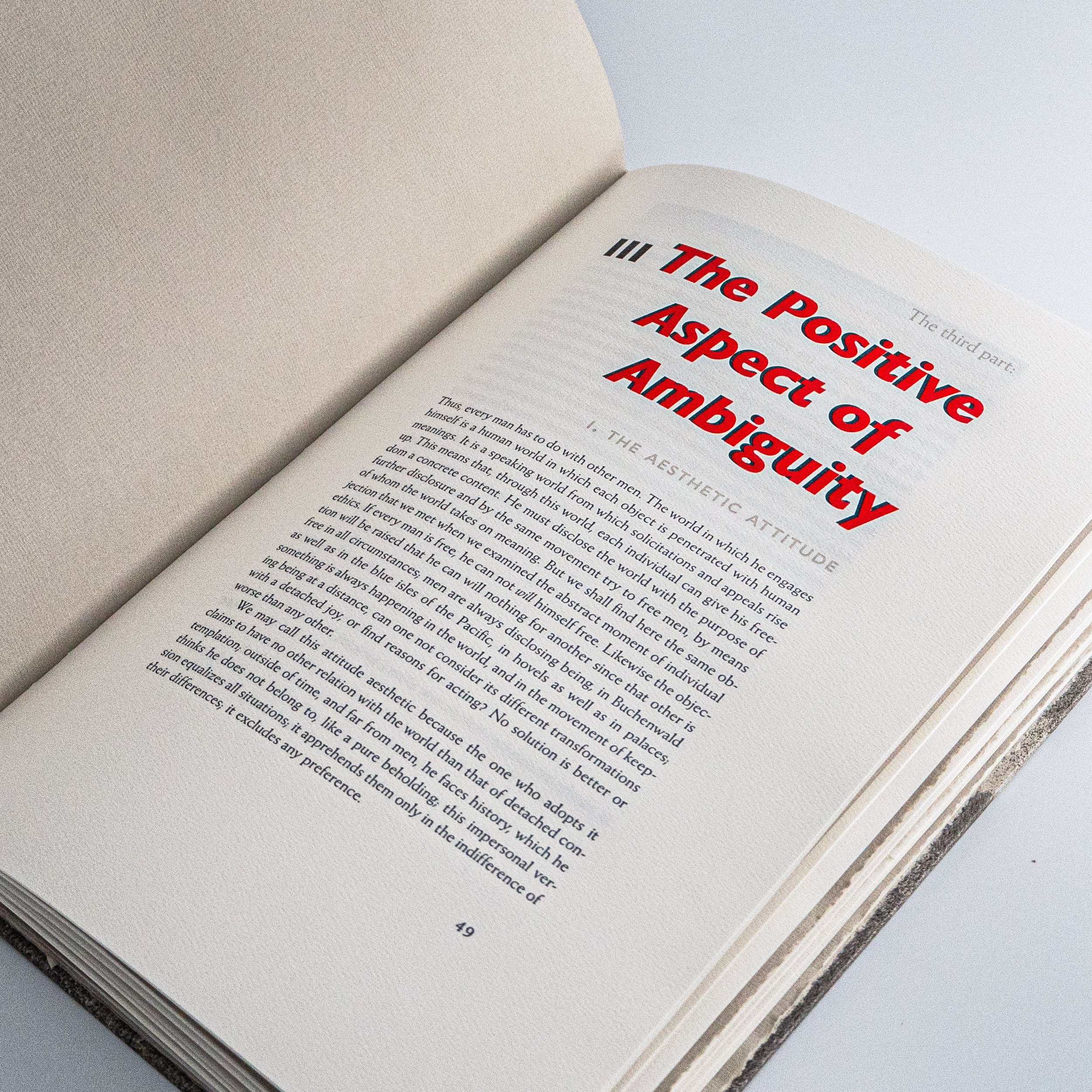
•⠀Printed letterpress on a hand-operated Vandercook Universal I proofing press, with two-color printing on every page.
•⠀Mohawk feltmark and Hahnemühle Ingres.
•⠀Each copy includes a separate chapbook introduction by Jacob Roundtree and a short commentary on the artworks.
STANDARD
•⠀Limited to 50 numbered copies.
•⠀Bound in a French livre de luxe style using Khadi handmade paper.
•⠀Housed in a slipcase.
DE LUXE
•⠀Limited to 20 numbered copies.
•⠀Bound in a three-piece Bradel binding with painted boards.
•⠀An accompanying suite of all sixty artworks.
•⠀All housed in a slipcase and chemise.