Why make books by hand?
Why make books by hand?
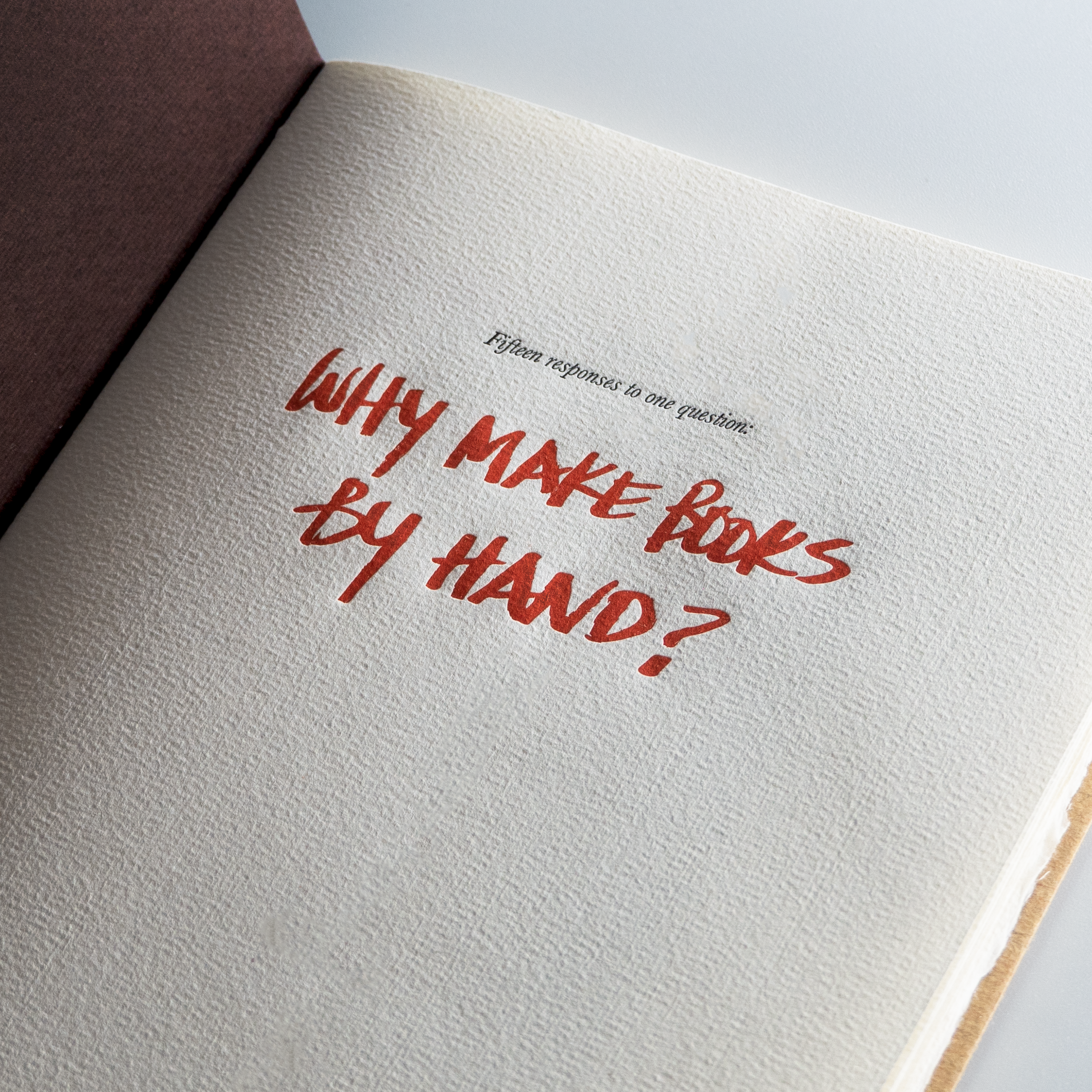
FIFTEEN RESPONSES TO ONE QUESTION
For several years, I have been asking book-makers of every sort to answer this question: “Why make books by hand?”
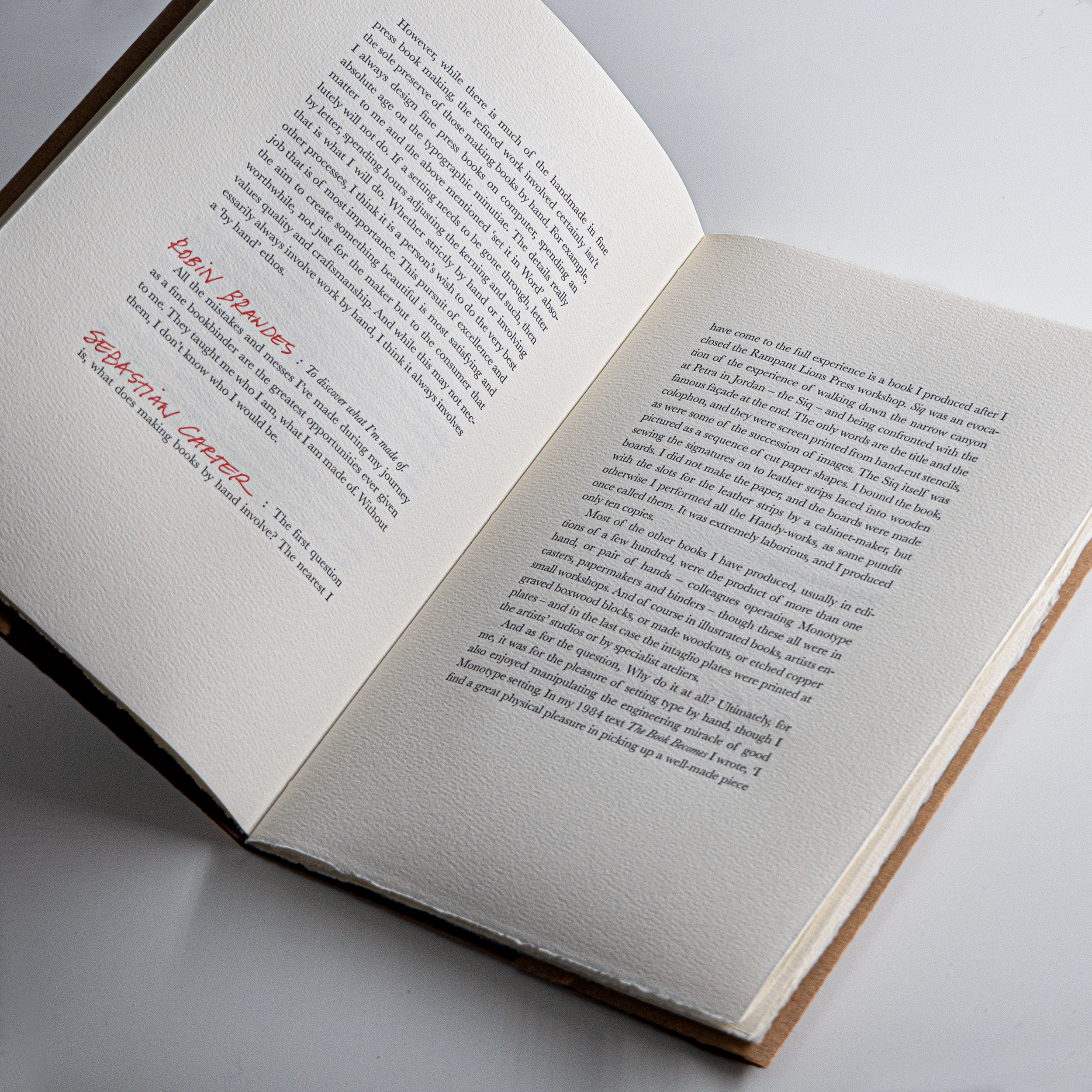
This is the first collection of responses, featuring short essays byMark Askam, e bond, Robin Brandes, Sebastian Carter, André Chaves, Samuel Feinstein, James Freemantle, Jamie Murphy, Andrew Miller-Brown, David Pascoe, Chad Pastotnik, Sol Rébora, Gaylord Schanilec, Christopher Wakeling, and – best of all – my own assistant bookmaker Claire McArthur.
I notice that the question has a prismatic effect, for “Why make books by hand?” easily becomes “Why print books by hand?” and “Why bind books by hand?” and “Why collect books made by hand?” And “by hand” itself is a notion with some controversy. Some are content to let “handmade” describe crafts which involve human hands to a far greater extent than the technologies of the day require; others criticize the term when (mis?)applied to crafts involving machinery, often electric machinery. And there is always the possibility of complicating the idea of something being handmade with a “turtles all the way down” investigation. “Sure, you might sew a book by hand using thread and needle – but how were the thread and needle made?” Suffice it to say, this collection of essays will not unveil with gusto some definitive, perfectly formed definition of the quixotic “by hand.” Each essayist approaches the question with their own assumptions about what our craft terms connote, and many investigate them. This is one of the great pleasures, I think, of our loosely confederated “book arts” community: We are big enough to have a vocabulary, but not so big that our vocabulary is strictly defined. We are better for it.
The presence of human hands in bookmaking has a tumultuous relationship to bookmakers. Some treat “making by hand” as a semi-sacred rite; others treat it as a plain nuisance. In this series, you will read some essays which, frankly, do not consider it of particular importance.
Whatever its significance, the hand is ever-present. This year I had the pleasure of visiting the largest book factory in Oregon. I was surprised to see that several parts of their process still involved a bit of handicraft. The factory’s owner told me that eventually he hoped to invest in the machinery to do away with these bottlenecks. Others create bottlenecks by sticking their hands where, truly, it is no longer necessary. One bookbinder I know insists on cutting paper with nothing but their own hands by folding and tearing – a guillotine or shear would rob them of this simple pleasure.
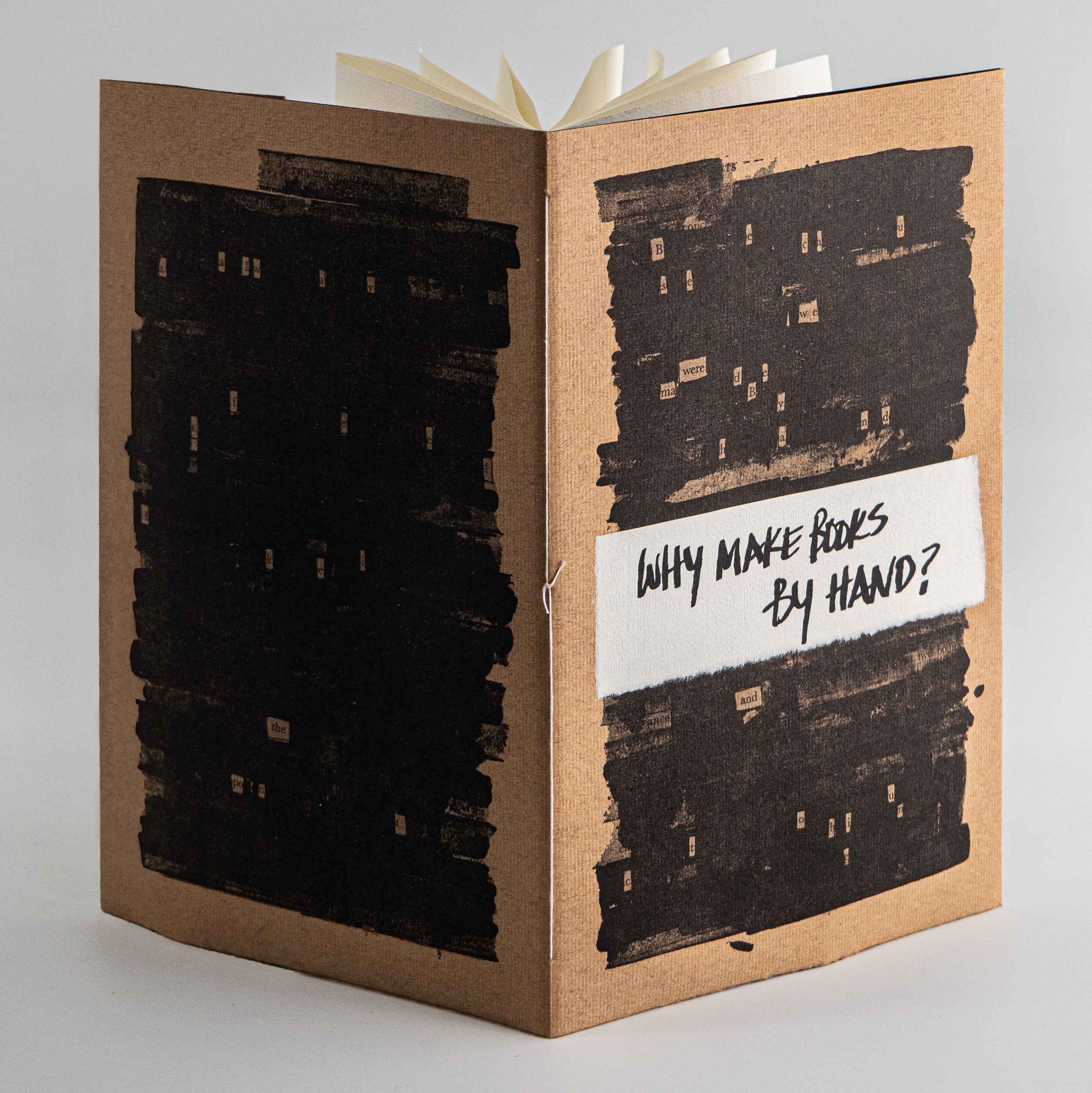
The contributors were asked only to respond to the question. No other parameters were given, and I have printed their responses without intervention. Here we have the proprietors of private presses, of fine presses, bookbinders and publishers, collectors all. To exhaust the list of those whose responses I’d love to read, I’d need at least two hundred further essays. But this is a great start. I am earnestly touched that the extraordinary bookmakers here assembled have given their time to answer my question. My heartfelt thanks to them. And I am especially grateful to e bond, whose response in the form of a found poem serves as the chapbook’s cover, and whose calligraphy is found throughout.
COLOPHON
•⠀A chapbook from No Reply, 2 0 2 5.
•⠀Limited to 1 5 0 (ish) copies.
•⠀Measuring 6 ¼ by 9 ½ inches and 24 pages.
•⠀Printed letterpress on a hand-operated Vandercook Universal I proofing press.
•⠀Hahnemühle Ingres papers, printed in two colors throughout.
•⠀Sewn into a stiff wrapper with e bond’s response to the question printed letterpress from a magnesium plate.